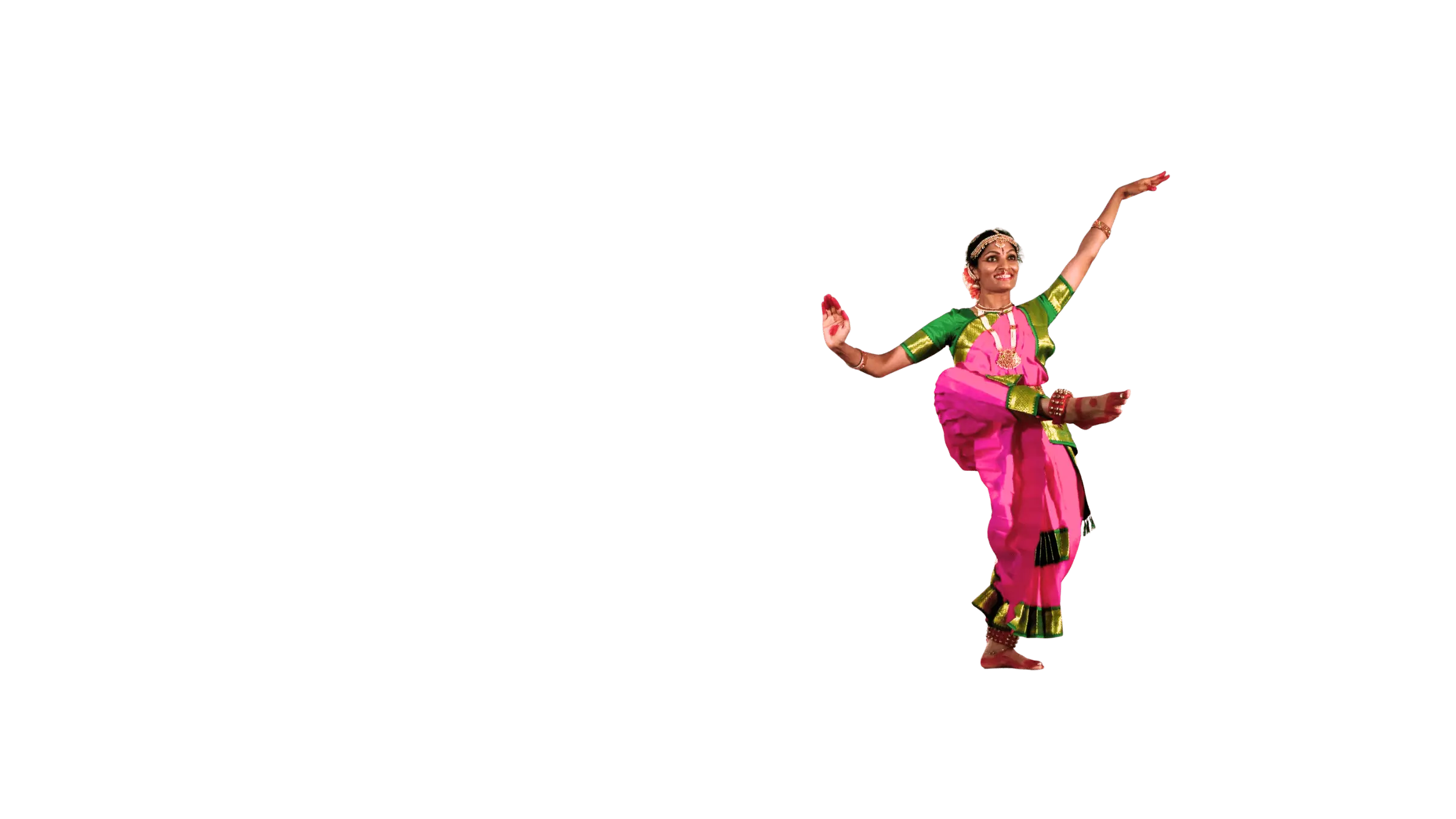
A Kuchipudi dancer mid-phrase, arms extended, on a lit stage

కూచిపూడి

A dance that began as a play


Kuchipudi is a classical dance form from a village of the same name in coastal Andhra Pradesh. It grew out of temple theatre rather than solo dance, and it kept something the other classical forms gave up: the dancers speak.

What it is

Three things happening at once

Classical Indian dance is built from three elements. They are not three styles or three schools. They are three things a body can be doing, and a Kuchipudi performance moves between them, sometimes inside a single phrase. Knowing which one you are watching changes what you see.

నృత్తం

Nritta

Pure movement

Rhythm and footwork with nothing attached to it. No story, no character, no line of text being illustrated. The body keeps time against the drum and the cymbals, and the pleasure of it is the pleasure of pattern resolving.

It is the part of the form closest to architecture. A phrase is built, repeated, varied, and landed on the first beat of the cycle. When a dancer is doing nritta well, you can follow the mathematics without knowing any of the vocabulary.

నృత్యం

Nritya

Movement that means something

The same body, now carrying a text. The hands take shapes that stand for things — a deer, a lotus, a refusal — and the eyes and the face carry the feeling the words are describing. The music is singing a line, and the dancer is saying it again in another language.

A single line of poetry may be repeated many times, danced differently each time. That is not indecision. It is the dancer turning the line over, finding what else is in it.

నాట్యం

Natya

Drama

The dancer stops representing and starts being. There is a character with a name, a situation, and something at stake — an argument, a plea, a moment of recognition. In Kuchipudi this is not an occasional flourish. It is where the form came from.

It is also where Kuchipudi keeps a door the other classical forms mostly closed. The performer may speak, and may sing, in the character's own voice.

Where it comes from

కూచిపూడి

A village gave the dance its name

The village. Kuchipudi is a real place — a village in Movva mandal, Krishna district, in coastal Andhra Pradesh. The name is a shortening of Kuchelapuram. It is one of the few classical dance forms named after a specific village rather than a region, a temple or a text, and the families who lived there carried the tradition for generations.

The teacher. The tradition traces itself to Siddhendra Yogi, who is credited with composing Bhamakalapam and with teaching it to the brahmin boys of the village, binding them to perform it. Beyond that, the record is thin and the sources disagree. Dates offered for him range across three centuries, and some accounts place him as a disciple of the saint Tirtha Narayana Yati while others do not. The honest position is that the story is firmly held and poorly dated.

The turn. For most of its history Kuchipudi was danced by all male troupes of brahmin performers, in the village and on tour, as theatre rather than as concert dance. That changed within living memory. Vedantam Lakshminarayana Sastry is credited with teaching the form to women in the early twentieth century. The All India Dance Seminar convened by the Sangeet Natak Akademi in 1958 put it on a national stage. And the solo repertoire most people now recognise as Kuchipudi was shaped largely in the second half of the twentieth century, above all in the school of Vempati Chinna Satyam.

What that means. A form that was communal, male and dramatic became one that is largely solo, largely danced by women, and performed on a proscenium stage. Both things are Kuchipudi. Knowing that the second grew out of the first is most of what it takes to watch it properly.

More on the history in the journal

Telling it apart

What makes it Kuchipudi

To an eye that has not been trained, the Indian classical forms look like variations on one thing. They are not. Kuchipudi and Bharatanatyam in particular are often confused, and the differences are easy to see once somebody points at them.

  • The dancers speak

    This is the difference people notice first. A Kuchipudi performer may deliver dialogue and may sing, in the character's voice, as part of the performance. Bharatanatyam is danced in silence; the singer is somebody else. Kuchipudi kept the actor inside the dancer.

  • It began as theatre

    Kuchipudi came out of troupe dance-drama with named characters, a narrator and a plot that ran for hours. Bharatanatyam came out of solo temple dance. The solo Kuchipudi item you are most likely to see today is a twentieth-century development from an older group form, not the other way round.

  • The character introduces herself

    A dance-drama character traditionally enters with a passage in which she announces who she is. The dancer is not a neutral body illustrating a song; she has arrived as somebody, and the audience is told so. That convention survives in the solo repertoire.

  • The brass plate

    In the tarangam, the dancer performs footwork standing on the rim of a brass plate, frequently with a pot of water balanced on the head. It is the single most recognisable image the form has, and no other Indian classical style does it.

  • It travels

    Kuchipudi tends to be rounder and more mobile — more covering of the stage, more elevation, lines that continue past the body rather than stopping at it. Bharatanatyam tends to be more angular and more anchored, held in a deep half-sit. These are tendencies, not laws.

  • It is Telugu

    The texts are in Telugu and Sanskrit, and the sensibility is Telugu too — the poetry, the humour, the particular devotion to Krishna that runs through the repertoire. Bharatanatyam's core repertoire is largely Tamil and Sanskrit.

A caution worth stating plainly: living traditions do not sit still, and every one of these has exceptions. Teachers within the same form disagree about where its boundaries are. Take the list as a way of starting to see the difference, not as a set of rules either tradition has signed.

The repertoire

What gets danced

A Kuchipudi programme is built from named items, each with its own job. Some are pure rhythm, some are pure story, and the order they come in is a decision the dancer makes about how to take an audience somewhere.

  • A dancer in the role of Satyabhama, in full costume and headdress

    భామాకలాపం

    Bhamakalapam

    The dance-drama the tradition traces to Siddhendra Yogi, and the work the form is built around. Satyabhama, Krishna's proud and difficult queen, is separated from him and has to find her way back. Pride, quarrel, longing, reconciliation — played at length, with dialogue.

  • A dancer performing footwork on the rim of a brass plate

    తరంగం

    Tarangam

    Set to verses from Narayana Teertha's Sri Krishna Leela Tarangini, a Sanskrit work in twelve sections on the life of Krishna. Tarangam means wave. This is the item danced on the brass plate, and often with a pot of water carried on the head.

  • A dancer mid footwork sequence, feet in motion

    జతిస్వరం

    Jatiswaram

    Pure nritta. Rhythmic syllables and melodic phrases with no text to interpret and no character to play. It is where a dancer's training is most exposed, because there is no story to hide behind.

  • A dancer holding a mudra, eyes directed along the hand

    శబ్దం

    Shabdam

    Where rhythm and meaning first meet. A sung text, usually in praise of a god or a patron, danced with both footwork and expression. For a student it is often the first item in which the hands have to say something rather than simply keep time.

  • A dancer seated, in a moment of stillness and expression

    పదం

    Padam

    Slow, and almost entirely expression. A short poem, often about longing, is turned over line by line. Very little happens and everything happens. This is the item by which mature dancers are usually judged.

  • A dancer in a bright closing pose, arms raised

    తిల్లానా

    Tillana

    The bright finish. Fast, sculptural, built from rhythmic syllables with only a fragment of text at the end. A programme usually closes here, on the audience's pulse rather than on their feelings.

The vocabulary

Words you will hear in class

Most of the teaching happens in Telugu and Sanskrit terms, and no teacher stops to translate them twice. Here are the ones that come up in the first month.

నృత్తం Nritta
Pure movement. Rhythm and footwork with no text to carry.
నృత్యం Nritya
Expressive dance. Movement carrying a meaning.
నాట్యం Natya
Drama. The dancer becomes a character in a situation.
అభినయం Abhinaya
The whole craft of expression — face, eyes, hands, body, voice.
హస్తం Hasta
A hand position. Also called mudra, the gesture it forms.
తాళం Tala
The rhythmic cycle. The count everything is measured against.
రాగం Raga
The melodic mode a piece is set in, and the mood it carries.
జతి Jati
A phrase of rhythmic syllables, spoken and then danced.
నట్టువాంగం Nattuvangam
The cymbals that lead the dance, and the art of leading with them.
మృదంగం Mridangam
The double-headed drum at the centre of the accompanying ensemble.
కలాపం Kalapam
A dance-drama. Bhamakalapam is the best known of them.
దరువు Daruvu
A sung passage belonging to one character inside a kalapam.
సూత్రధారి Sutradhari
The narrator who holds a dance-drama together and speaks to the audience.
ఆహార్యం Aharya
Costume, jewellery and make-up, understood as part of the performance.

Where to go next

Reading about it only gets you so far


Everything on this page is the outside of the form. The inside of it is learned in a room, slowly, by doing one thing badly until it becomes one thing done well. If that appeals to you, we teach it — in Montreal in person, and anywhere else online.

శ్రీ నృత్యాలయం